
WELCOME BONUS 300%
UP TO €2000 + 100
FREE SPINS
UP TO €2000 + 100
FREE SPINS
Home → Games
All casino games at Mainio Casino
Straight-Up 35:1 Against 1-in-37 Odds
A straight bet on the European wheel pays 35:1 while the true chance is 1 in 37 pockets, because the single zero sits among numbers 1 through 36. The payout is set as if there were 36 pockets, so the casino keeps 2.70% house edge on every straight wager. Over 100 € of repeated straight bets, the average cost is 2.70 €.
The American wheel carries 38 pockets with both 0 and 00, yet the straight still pays 35:1. That extra pocket doubles the house edge from 2.70% to 5.26%, making the same 100 € of straight stakes cost 5.26 € on average. A player comparing the two wheels sees the RTP drop from 97.30% to 94.74%.
A single number hit on either wheel returns 35 € for each 1 € staked, but the probability differs: 1 in 37 against 1 in 38. The European straight over hundreds of thousands of spins returns 97.30% RTP as a long-run average, never a session forecast. The American version keeps 5.26% instead of 2.70%, which is exactly double.
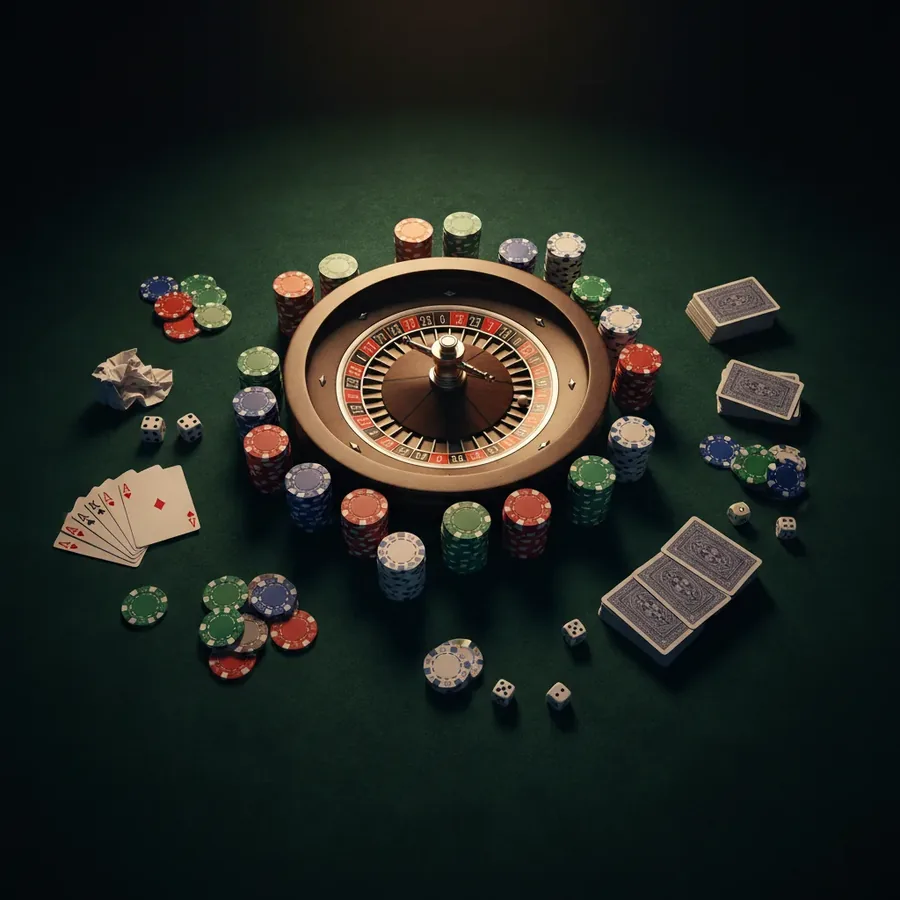
The Craps Odds Bet: 0% House Edge
The craps free odds bet is the only casino wager with a 0.00% house edge, because it pays at true odds once a point is set. Available only on top of Pass Line or Don't Pass, it returns 100.00% RTP on the odds portion itself. A point of 4 or 10 pays 2:1, 5 or 9 pays 3:2, and 6 or 8 pays 6:5.
In the 3-4-5x mode, the combined Pass Line plus odds figure reaches 99.63% RTP, cutting the edge to 0.37% on the total action. The Pass Line alone carries 1.41% house edge per resolved bet, with 98.59% RTP. Adding odds lowers the per-roll combined edge to 0.111%, while at 1x odds it is 0.251% and at 2x odds 0.180%.
The Don't Pass and Don't Come bet runs at 98.64% RTP with a 1.36% house edge, slightly better than the Pass Line because 7 wins and 12 is sometimes a push. Its per-roll edge is 0.40% with a standard deviation of 0.99. The Pass Line standard deviation is 1.00, and Come has identical maths to Pass.
Dozen Bets at 2:1: Twelve Numbers, a Third of the Wheel
A dozen bet covers twelve numbers and pays 2:1 on the European wheel, where 37 pockets set the true chance at 12 in 37. The payout is calculated as if 36 pockets existed, so the house edge stays 2.70% and RTP at 97.30%. For every 100 € staked on dozens, the average retained amount is 2.70 €.
The American wheel also pays 2:1 for a dozen, but with 38 pockets the house edge rises to 5.26% and RTP falls to 94.74%. The same 100 € in dozen stakes costs 5.26 € on average. Both wheels keep the identical payout for the bet type, yet the extra zero pocket changes the long-run cost by 2.56 percentage points.
A column bet pays the same 2:1 and covers twelve numbers in a vertical arrangement instead of the sequential dozens. The European column carries 2.70% house edge, identical to the dozen because all outside bets on the single-zero wheel share that edge. The six line pays 5:1 for six numbers, and the corner pays 8:1 for four.
RNG vs Live Roulette: Four Clear Differences
An RNG roulette round uses a random number generator to select one of 37 pockets on the European wheel, with payouts such as straight 35:1, split 17:1 and corner 8:1 unchanged from the live table. The house edge remains 2.70% and RTP 97.30% because the maths does not depend on the delivery method.
A live table shows the same 37-pocket wheel with a dealer spinning physically, while the American live version has 38 pockets including 0 and 00. The RTP on American roulette is 94.74% against 97.30% for European, so the wheel type matters more than whether it is RNG or live. A straight bet pays 35:1 on both platforms.
The red or black bet pays 1:1 on the European wheel and on the American wheel, yet the American version carries 5.26% house edge instead of 2.70%. RNG and live tables with a single zero keep the same 2.70% edge, and the dozen or column pays 2:1 in either setting. The six line at 5:1 also stays identical across delivery methods.
Split 17:1 vs Corner 8:1: Payouts Compared
A split bet on two adjacent numbers pays 17:1 on the European wheel, while the true chance is 2 in 37 because of the single zero. The house edge is 2.70% and RTP 97.30%, the same as every other bet on that wheel. Over 100 € of split stakes, the expected average cost is 2.70 €.
A corner bet covers four numbers and pays 8:1, again set as if only 36 pockets existed. On the American wheel with 38 pockets, the corner payout stays 8:1 but the house edge doubles to 5.26% and RTP drops to 94.74%. The split also pays 17:1 there, with the same 5.26% edge.
The street bet sits between them, covering three numbers at 11:1 on the European wheel. All three inside bets share the 2.70% house edge on the single-zero layout, while the six line pays 5:1 for six numbers. On the American wheel, each of these payouts remains fixed but the edge rises to 5.26% because of the extra 00 pocket.
Game categories at a glance
| Category | Examples | Stakes From | Highlight |
|---|---|---|---|
| Slots | Book of Demi Gods 2, Cygnus 4, Jammin' Jars | 0.10 EUR | thousands of titles |
| Table games | Roulette, Blackjack, Baccarat | 0.50 EUR | classic rules |
| Live casino | Casino Hold'em, MONOPOLY Live | 0.20 EUR | real dealers |
| Jackpot games | Mega Moolah, Divine Fortune, Age of the Gods | 0.20 EUR | progressive pools |
| Instant games | Aviator, Plinko, Mines | 0.10 EUR | fast rounds |
| Video poker | Jacks or Better, Deuces Wild | 0.25 EUR | strategy based |
Game Shows: Sectors, Multipliers and Bet Ranges
Sic Bo Special bets carry RTPs from 81.48% to 92.13%, a spread of 10.65 percentage points inside one game family. The Single Number bet sits at the top of that range with a house edge of 7.87%, while the Specific Double is the worst at 18.52%, so the gap between best and worst special bet is more than double. A player staking €100 across Specific Double wagers hands over €18.52 on average, against €7.87 on Single Number.
The pay tables explain the spread. Specific Triple pays 180:1, Any Triple 30:1, Specific Double 10:1, Two-Dice Combo 5:1, and Single Number pays 1:1, 2:1 or 3:1 depending on how many dice match. Any Triple returns 86.11% and Specific Triple 83.80%, so the headline 180:1 is not the best value on the layout.
Bet ranges on live game shows are therefore less important than the bet type chosen within them. A Specific Triple at 180:1 leaves a house edge of 16.20%, while Single Number at 1:1 leaves 7.87% — the smaller-looking payout keeps more money with the player. The practical consequence: on a €200 sic bo session, the difference between the two bets is about €16.66 in expected cost.
Double Down: Doubling Your Bet After Two Cards
Doubling after a split improves blackjack RTP by about 0.14 percentage points, and the move doubles the stake in exchange for exactly one more card. Resplitting aces adds 0.08 percentage points, while the dealer hitting soft 17 subtracts 0.22 percentage points — more than the two favourable rules combined. On a €10 base bet, doubling commits €20 to a single card.
The 6:5 blackjack payout shows how quickly rule changes outweigh tactics. Replacing 3:2 with 6:5 adds 1.39 percentage points to the house edge, taking RTP to 98.15% and the edge to 1.85%; a €10 blackjack pays €12 instead of €15. That single rule change costs three times what doubling after a split gains.
Insurance is the side bet to decline: at 92.53% RTP and a 7.47% house edge over six to eight decks, it is far worse than the main hand. Basic strategy always refuses it, and only card counters at a true count of +3 or higher have a reason to take it. Insurance pays 2:1 and covers up to 50% of the main bet.
Jacks or Better: Check Payout Table Before Betting
Jacks or Better 8/5 returns 97.29% with a house edge of 2.71%, because the full house pays 8 and the flush pays 5. The 9/6 version, by contrast, reaches 99.54% and a 0.46% edge — the two-unit cut on just two payouts costs 2.25 percentage points of RTP. On €100 of stakes, that is €2.25 extra to the casino.
The intermediate tables sit between those poles: 9/5 pays 98.45%, 8/6 pays 98.39%, 7/5 pays 96.15% and 6/5 pays 94.99%. A player who does not read the pay table before inserting money can therefore sit on a game whose edge is six times the best available version. The Royal Flush pays 800 on all of them, so the headline jackpot tells nothing about the table's value.
Deuces Wild — Not So Ugly Ducks is the near-full-pay alternative at 99.73% RTP and a 0.27% house edge, with Five of a Kind at 16 and Four of a Kind at 4. Illinois Deuces, a different deuces variant, returns 98.91%. The two games have different volatility, so the 0.82 percentage point gap between them is not the only difference a player should weigh.
Straight, Split, and Corner: Three Terms Briefly Explained
On the European wheel, a straight pays 35:1, a split 17:1 and a corner 8:1, with a street at 11:1 and a six line at 5:1. The single-zero layout returns 97.30% on every one of these bets, because the 37 pockets are paid as if there were 36 — so the house edge stays at 2.70% regardless of which shape a player covers.
The American wheel keeps the same payouts but adds a double zero, making 38 pockets. RTP drops to 94.74% and the house edge rises to 5.26%, roughly double the European figure. A €100 straight-up bet on the American layout costs €5.26 on average, against €2.70 on the European one — same odds, same chip, nearly twice the price.
Coverage size changes variance, not the edge. A corner at 8:1 covers four numbers, a split covers two and a straight covers one, but on the single-zero wheel each carries the identical 2.70% house edge. That is why the choice between them comes down to how often a player wants to be paid, not to expected value.
When Does Splitting Aces and Eights Make Sense?
Splitting is the mechanical part: the stake is matched and up to four hands can be created, with split aces usually receiving one card each. Resplitting aces improves RTP by 0.08 percentage points, and doubling after a split adds about 0.14 percentage points. On a €10 hand, a split commits a second €10 before any card is drawn.
The 6:5 payout is the constraint that decides whether splitting is worth it. At 6:5, blackjack pays €12 on a €10 bet instead of €15, RTP falls to 98.15% and the house edge rises to 1.85% — an extra 1.39 percentage points. Every split doubles exposure, so the weaker payout is paid twice.
Deck count is the smaller factor: six decks instead of eight moves RTP by roughly 0.02 percentage points, far less than the 0.22 percentage points lost when the dealer hits soft 17. A player weighing a split on aces or eights should check the blackjack payout and the soft-17 rule first, because those two rules decide the value of the extra stake.
Corner Pays 8:1, Dozen Only 2:1
A corner bet in European Roulette covers four numbers and pays 8:1, while a dozen bet covers twelve numbers and pays only 2:1. With 37 pockets on the wheel, a corner covers 4 of 37 numbers and a dozen covers 12 of 37, so the dozen wins far more often but pays much less per unit staked. Staking €10 on a corner returns €80 plus the stake when it lands, against €20 plus the stake on a dozen.
The house edge on European Roulette stays at 2.70% on both bets because payouts are set as if the wheel had 36 pockets. A straight bet pays 35:1, a split 17:1 and a six line 5:1, so the corner at 8:1 sits between the split and the street at 11:1 in the payout order. Across 100 rounds at €10 per bet, the average cost is €27 regardless of which of these bets is chosen.
American Roulette carries the same corner payout of 8:1 and the same dozen payout of 2:1, but 38 pockets lift the house edge to 5.26%. That difference means €100 staked on corners costs €5.26 on average on the American wheel against €2.70 on the European version. The corner keeps its 8:1 return, yet the extra double zero pocket takes a larger average share.
American Roulette: 5.26% Because of the Double Zero
American Roulette uses 38 pockets, numbered 1 to 36 plus 0 and 00, and carries an RTP of 94.74% with a house edge of 5.26%. The payouts match the European wheel exactly, with a straight at 35:1 and a split at 17:1, but the additional pocket raises the average cost of every bet. On €100 staked across straight bets, the American wheel keeps €5.26 against €2.70 on the 37-pocket European version.
That gap of 2.56 percentage points is the direct effect of the double zero, since the two wheels pay identically while only one carries an extra losing pocket. European Roulette lists an RTP of 97.30%, so the American game returns roughly 2.56 percentage points less to players over the long run. Staking €200 on red or black costs €10.52 on average in American Roulette against €5.40 in the European version.
Outside bets such as red or black at 1:1, odd or even at 1:1 and 1-18 or 19-36 at 1:1 all carry the same 5.26% edge on the American wheel. A dozen bet at 2:1 and a column bet at 2:1 are equally affected, because the extra pocket sits outside every outside bet. Only the straight bet at 35:1 covers a single number, and it too absorbs the full double zero penalty.
The Four Decisions in Every Blackjack Hand
Blackjack decisions turn on a small set of rule modifiers, and each one shifts the house edge by a measurable amount. A dealer who hits soft 17 adds 0.22 percentage points to the edge, while doubling after a split removes about 0.14 percentage points and resplitting aces removes 0.08 percentage points. Playing six decks instead of eight changes the edge by about 0.02 percentage points.
Doubling allows the player to raise the stake to twice the original with one card, and splitting turns one hand into two, with up to four hands in total. Split aces usually receive one card each. A 6:5 payout on a blackjack instead of 3:2 adds exactly 1.39 percentage points to the edge, more than any other single rule change, so a €10 blackjack pays €12 rather than €15.
Insurance is a side bet of up to 50% of the main bet when the dealer shows an ace, and it pays 2:1. With six to eight decks it carries an RTP of 92.53% and a house edge of 7.47%, and basic strategy always declines it. With a single deck the edge is about 5.88%, which is still far above the main game and confirms that the side bet costs far more per euro staked.
Splitting in Blackjack: One Hand Becomes Two
Splitting converts one starting hand into two, with up to four hands in total, and each new hand receives its own stake equal to the original. Doubling after a split improves the player's position by about 0.14 percentage points, while resplitting aces improves it by 0.08 percentage points. Both are rule-dependent modifiers, so a table without them carries a slightly higher house edge than one that offers them.
Split aces usually receive one card each, which limits the upside compared with other split pairs. A 6:5 blackjack payout instead of 3:2 adds 1.39 percentage points to the house edge, the largest single rule penalty, so a €10 blackjack pays €12 rather than €15. Playing a six-deck shoe instead of eight decks shifts the edge by roughly 0.02 percentage points in the player's favour.
A dealer who hits soft 17 adds 0.22 percentage points to the house edge, which is larger than the combined benefit of doubling after a split and resplitting aces at 0.22 percentage points. Insurance, a separate side bet of up to 50% of the main bet when the dealer shows an ace, pays 2:1 but carries a 7.47% house edge with six to eight decks. Basic strategy therefore declines insurance while still splitting and doubling where the rules allow.
Contact
Live - online chat
Banking









Providers












Mainio Casino 2026